When "Looks Real" Isn't Real
An Expanded Analysis of the Emerging Synthetic Media Threat Landscape and Zero Trust Countermeasures
Expanded Analysis Based on DrZeroTrust Research - Version 1.1 - September 19, 2025
Executive Summary
The democratization of generative AI has fundamentally transformed the threat landscape, empowering criminal enterprises and state-sponsored threat actors to manufacture plausible synthetic media at industrial scale with minimal investment.
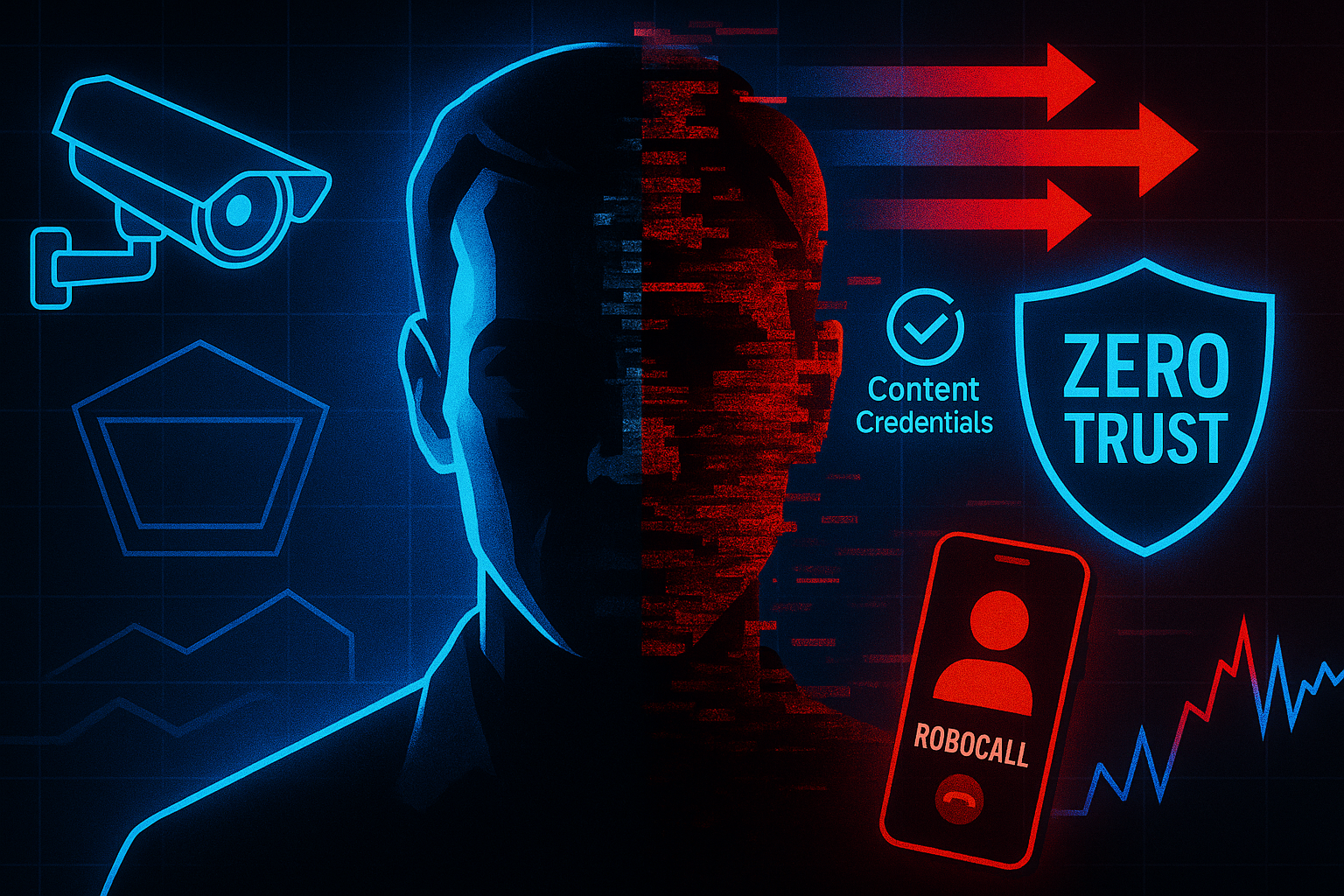
Key incidents demonstrate the severity: Arup lost US$25 million to a deepfake video call fraud in 2024 where attackers impersonated multiple executives simultaneously. AI robocalls mimicking President Biden's voice were used to suppress voters in the New Hampshire primary, resulting in a $6 million FCC fine. A Pentagon explosion AI-generated image caused real market volatility in 2023. Slovakia's 2023 elections were disrupted by deepfake audio of a candidate discussing vote rigging, released 48 hours before polls opened when fact-checking couldn't keep pace.
The Threat Landscape: The Synthetic Influence Kill Chain
Modern deepfake attacks follow a six-phase kill chain: reconnaissance (gathering target voice and video samples from public sources), model training (fine-tuning generative models on target data), pretext development (crafting believable scenarios), direct engagement (deploying synthetic media against targets), amplification (spreading through social and traditional media), and exfiltration (monetizing the attack through fraud, market manipulation, or political disruption).
Audio deepfakes are particularly dangerous because humans detect them at near-chance accuracy levels. Meta-analysis shows detection rates of only 55-60%, and training provides only modest improvement. The cost of producing convincing deepfakes has collapsed, making this accessible to mid-tier criminal organizations, not just nation-states.
Zero Trust for Information
The framework extends Zero Trust principles to treat every message and media as untrusted until verified. This includes identity integration (multi-factor verification of all communications), device security (trusted endpoints only), network controls (authenticated channels), application integration with C2PA Content Credentials (provenance tracking for all media), and data protection with golden records (verified reference points for critical communications).
The core principle: never trust, always verify applies to information itself, not just network access. Every communication claiming to be from an executive, every image claiming to show reality, every audio clip claiming to capture a real conversation must be authenticated before being acted upon.
Implementation
Organizations should begin with a 90-day framework: Phase 1 (Days 1-30) establishes baseline detection capabilities and executive communication protocols. Phase 2 (Days 31-60) deploys technical controls including C2PA integration and out-of-band verification channels. Phase 3 (Days 61-90) conducts tabletop exercises and refines response procedures.
The synthetic media threat will only accelerate. Organizations that implement Zero Trust information principles now will be positioned to defend against attacks that most of their peers will not even detect.